

Stop asking what can I do? Start asking, what am I willing to risk?
The time for creating is now.

Right now, as I write this, Los Angeles is ablaze with five different fires. The systems to battle these fires are so worn thin that both Mexico and Canada have sent their crews and resources to help. There is currently no end in sight as the desert winds are predicted to pick up even more, breathing even more life into blazes. My heart aches for the people who have lost their homes, who have had their communities destroyed, and who have been breathing toxic air as they flee for their lives, leaving everything behind. And yet, when I look at the pictures, I cannot help but notice that all that is left are little charred squares of soil surrounded by a sea of asphalt streets. There are concrete swimming pools and foundations of single-family homes sprawled across the city. It is an insane way to live in the natural world. It is insane to live in a way where our actions continue to make our habitat more extreme and less hospitable to our ability to live here. And yet, that is what is happening.
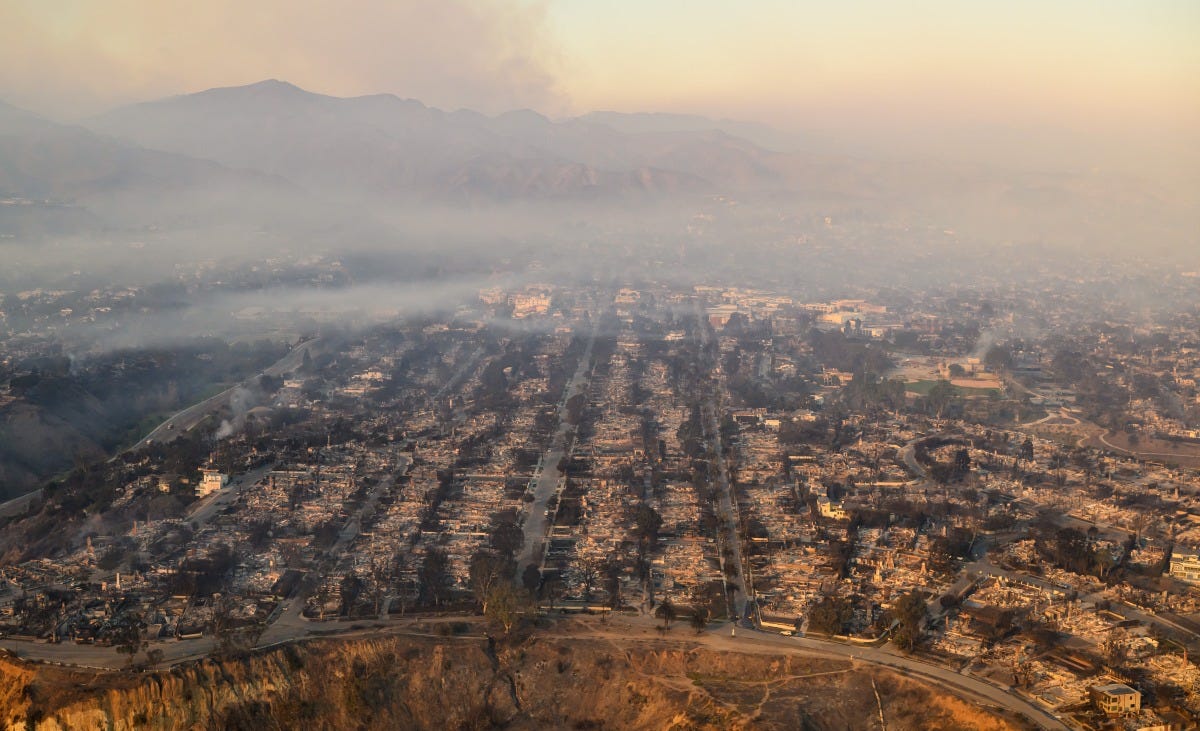
While you may read about global climate tragedies and might be dealing with symptoms near your home, it can be hard as one human being to remember the world is a global system. The trends, often broad and imperceptible to be noticed in our daily reality, are indeed changing. So I find it helpful, from time to time, to step back and ask myself: How is my ecosystem—our world—doing?
Here is a quick answer: Global temperatures in 2024 were 1.5°C (2.7°F) greater than the pre-industrial revolution average. We are in the Earth’s 6th mass extinction, and 100-200 species go extinct every day. In 2023 alone, 28.3 million hectares (almost 70 million acres) of forest were lost. Thirty-three percent of global soil is degraded. Two billion people do not have access to clean drinking water, and 80% of wastewater is returned to the ecosystem untreated. Eleven million tons of plastic enter the ocean annually; plastics are now found in the placentas of humans and in the bodies of fish, and research is being done on nano-plastics in the brain. Ninety percent of fish stocks are overfished. Oceans have absorbed 30% of CO2 emissions. Nine out of ten people breathe polluted air, and ecosystem services like pollination, CO2 sequestration, and water purification are in decline.
The impacts of modern culture on our ecosystem have surpassed all acceptable limits. Right now, more than ever, we need solutions on how to shift and create something new, and one way to start is by asking different questions.
What can I do?
Most of the answers to this question that I have been able to discover so far are highly unsatisfactory. I can be a good citizen and recycle diligently, restrict my water use, travel less, urge political leaders to make sustainable choices by voting for people who say they care about the environment, eat local food that is grown with regenerative practices, skip meat, and buy less stuff. While these are good practices to live by, they are not enough. No matter how neurotic you are about making better choices or urging your friends and family to make better choices, what we are doing is not working. These options have been out there for a long time. It is not enough. Even if everyone on the planet did these things, it would not be enough.
Asking “What can I do?” confines your perspective to the limits of existing possibilities. It is a search for what other people have been doing, with the hope that there are solutions out there to copy, but if you travel around the world, you might notice that more and more places look the same: industrialized agriculture, annual crop reliance, plastic in waterways and blowing around the streets, sprawling developments of single-family homes, and loss of habitat for wildlife. There is no undiscovered, pristine place awaiting to become our answer. There is no fantasy world out there where things are going well and wanting to go back to when things were simpler only leads us closer to where the problems began.
“What can I do?” is rooted in solving problems with the tools of a culture that created those problems. And yet, modern culture has done little to halt—let alone reverse—the destruction. We know what needs to be done to regenerate the planet. The problem is that modern culture values the things that are destroying it more than it values our ecosystem. To do something truly different, you must go to the edge of these cultural values. This requires leaving something behind.
What am I willing to risk?
“What am I willing to risk?” asks you to look at the aspects of modern culture you are willing to leave behind in order to create something different. This could be physical comforts that consumerism provides, like using the convenient bank with ATMs everywhere who invest in gas and oil or being able to order any object in 2 days with premium shipping, but the biggest shift might not come from the physical world at all. The most outrageous things to risk might be the in the intangible world, like the stories about what you are capable of, the concepts about how the world works and will work in the future, the beliefs you have about other people and their potential or limitations, and the rules you let govern your life.
As you consider the parts of your tightly held constructs you might be willing to experiment with changing, you may notice some resistance. This is normal, in fact it is something to celebrate because more than likely, you have found something that tests your certainty about yourself and how the world works. Certainty is a tool of the status quo while examining your unexamined parts, assumptions, orientations about life is the domain of evolution, being an experimenter, and of trying something new.
If you are interested in going in an exploratory domains:
You could risk having the security and fantasy world that someone else will take care of the problem, and also the fantasy that you, just one little person cannot.
You could let go of your way of living where you support the illusion that you are in control. That you can figure it our and enter the domain of being a competent navigator and collaborator with other resources like opening yourself up to synchronicity, creation, that this moment right here is connected to a very different way of being, right here, right now.
That in order to take action or start something that you first need to know how to do it. That if you can make sense of something, it is a good idea or valuable direction to explore.
You could risk your tightly constructed and ordinary conception of what an ordinary human can do and how they can relate in the world, their potential to collaborate with other people or connect with nonhuman species, and leave an open door to more information than you previously thought was perceivable.
You could leave behind the notion that some people are special and create at a certain level because they have been gifted something you that do not have. You could risk becoming the creator or source for the relating you want to have with people, the community you want to live in, the system of resource exchange you want to engage in, and a network of interconnected communities you want to empower.
You could risk the idea that there could ever be someone to give you the next step, that there are no answers outside to go find so that you know what to do, and that you will have to experiment and try things out.
You could destroy the fantasy world that someone else will clean up the messes that you leave behind. That there is some entity taking your trash or recycling and doing something with it.
Asking what I am willing to risk questions your comfort within a destructive system and allows you to consider all the ways you can leave modern culture behind. It opens the door to shift your perspective to one of responsibility and creation. You step into the world as a source for something new to be born. You leave behind the need for others to dictate solutions and instead take responsibility for what is creating the problem.
The time has come to risk your certainty about how the world works and what you are capable of, to let go of small changes and quick fixes, and to start asking bigger questions.